
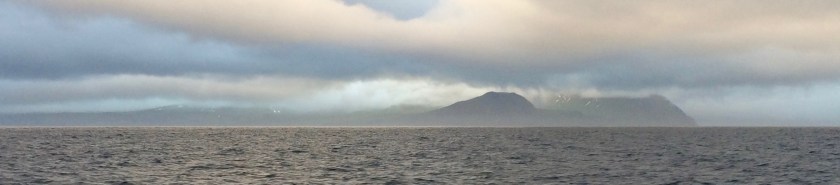
The Aleutian Islands are a vast, volcanic archipelago that runs west from the Alaska Peninsula towards the mainland of Russia. On a map, the islands are draped like necklace beads between the Bering Sea and the North Pacific Ocean. People don’t crowd to get to the Aleutians, at least not anymore, since most of the United States military installations there were abandoned after the Cold War. Many born-and-bred Alaskans have never set foot on an Aleutian Island.
It is June, 2016. The desert heat in my home town of Grand Junction, Colorado, is already building, but I am loading bags full of cold-weather gear to board a plane bound for Anchorage. Our final destination is the uninhabited island of Amchitka, one of the Rat Islands in the western part of the Aleutian Chain. The site of three underground nuclear detonations, it is distant, cold, and off-limits without a special permit. It is by far the most remote place I can ever hope to visit.
Every five years, scientific teams are sent to Amchitka Island to perform environmental monitoring for the U.S. Department of Energy, the long-term steward of the detonation sites. I am an ecologist by trade, a botanist by education, and I am fortunate to be chosen as a member of one of the teams. My job will be to measure and record the vegetation growing on landfill covers. Plants are an essential part of the cover design. The landfills contain hazardous wastes that were generated from drilling the holes for the underground detonations. The radioactive materials from the detonations themselves are entombed deep underground – none have ever been detected on the surface, in the ocean, or in the ecosystem. The once-classified detonations are now public record, and you can read about Amchitka Island on the Department of Energy Office of Legacy Management’s website. This blog in no way speaks for the Department of Energy or any of its contractors – this is simply an account of my personal adventure.


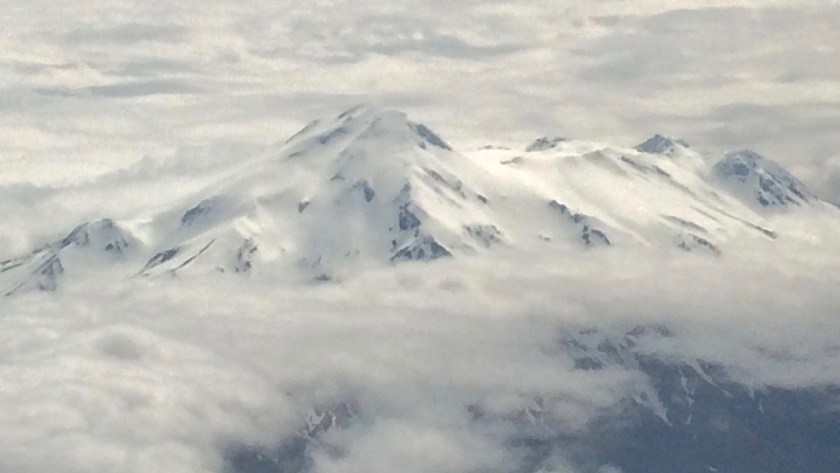
Left: The greening slopes of a volcano in the Andreanof Islands.
Right: Meltwater plunges down the black cliffs towards the sea
It will turn from spring to summer in the Aleutians, as we will spend the Summer Solstice there. If there is a warm spell up north, the temperature may top out at 50 degrees Fahrenheit (10 degrees Celsius). Chilly even in summer. The Aleutian Islands and the Bering Sea are not for the faint of heart. But my journey doesn’t begin with Amchitka Island. After a layover in Denver and a long flight, it begins with a night in Anchorage, the land of the midnight sun.
 for sure: despite political promises, it won’t be filled with millions of coal and petroleum industry and internal-combustion-engine-automobile-manufacturing jobs. It also won’t host teams of men who cut down old-growth forests or slaughter vast herds of wild bison for their tongues and tenderloins. These resources are on their way out, or they are already long depleted, reduced to island populations across our continent. Only so many ancient organisms were long ago turned into coal and oil beds. Their number was vast, but now they’re depleted, too. Like the bison. Like the old-growth trees. It’s a simple fact, no matter how many curtains you draw or cups of instant coffee you brew. Whether you “believe in” global climate change or not, the coal and steel industries are not coming back. We need to choose something else.

 Travels, Thoughts, and Tales by L.R.L. Sheader